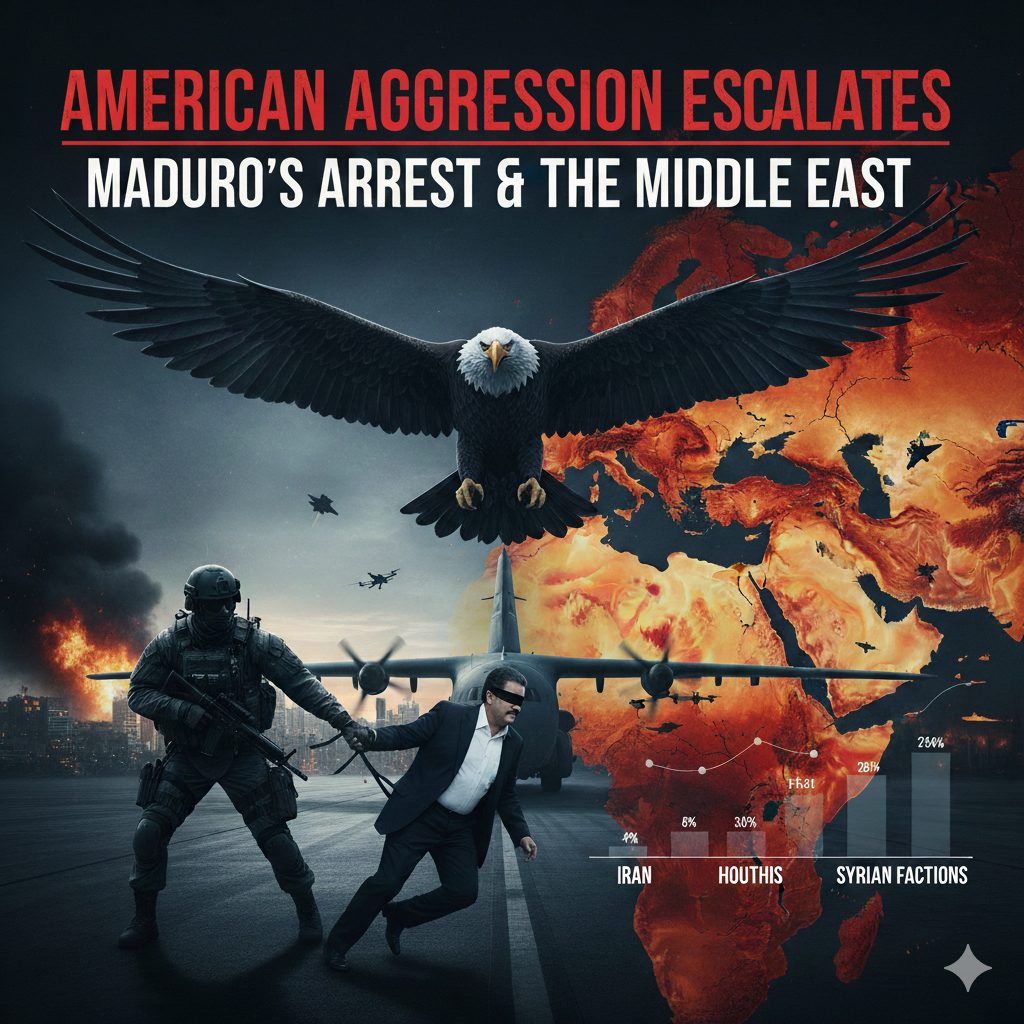
The recent capture of Nicolás Maduro by U.S. forces marks a historic shift in American foreign policy, signaling a transition from “maximum pressure” through sanctions to direct, kinetic intervention. On January 3, 2026, a large-scale U.S. military strike and raid in Caracas resulted in the apprehension of Maduro and his wife, Cilia Flores, who were subsequently transported to New York to face narco-terrorism charges.+1
This operation represents the most aggressive U.S. action against a foreign head of state since the 1989 invasion of Panama. For global observers, particularly in the Middle East, the message is clear: the U.S. is once again willing to use its military to execute domestic legal warrants against foreign leaders it deems “illegitimate” or “criminal.”
Why This Indicates Increasing Aggression
The capture of Maduro is not an isolated event but the culmination of a “Maximum Pressure 2.0” strategy. Several factors highlight this new level of assertiveness:
- Military Enforcement of Domestic Law: The U.S. justified a sovereign incursion using Department of Justice indictments, effectively treating a foreign leader as a common fugitive.
- Unilateral Action: The operation proceeded despite warnings from regional powers like Brazil and Colombia, signaling that the U.S. is prioritizing its own security and legal mandates over traditional multilateral diplomacy.
- Transition Management: President Trump’s statement that the U.S. will “run the country” until a transition occurs suggests a return to direct nation-building postures not seen since the early 2000s.
Which Middle Eastern Regimes Might Be Targeted Next?
With the “Maduro precedent” established, several regimes in the Middle East—already under intense U.S. pressure—are facing heightened risks of similar interventions.
1. Iran (The Islamic Republic)
Iran is the most likely candidate for increased kinetic action. The U.S. and Israel have already demonstrated a willingness to strike sensitive targets, such as the June 2025 strikes on Iranian nuclear facilities at Fordow.
- Why: Tehran’s “nuclear breakout” posture and its support for regional proxies (the “Axis of Resistance”) are viewed by Washington as existential threats.
- The Trigger: If the Iranian regime responds to domestic protests with mass violence, the U.S. has hinted at “rescue” missions, which could serve as a pretext for decapitation strikes or arrests of IRGC leadership.
2. The Houthi Leadership (Yemen)
While not a recognized state government by the U.S., the Houthis control significant territory and have been designated as a Foreign Terrorist Organization.
- Why: Continued disruption of global shipping in the Bab el-Mandeb and the Red Sea has made them a primary target for “law enforcement” via military means.
- The Trigger: Following the Maduro model, the U.S. could unseal indictments against Houthi leaders for piracy or terrorism, using those charges to justify special operations raids.
3. Elements of the Syrian “Shadow Government”
While the fall of Bashar al-Assad in late 2024 brought a new transitional government under Ahmed al-Sharaa, the region remains fractured.
- Why: The U.S. remains concerned about the “Syrian National Army” and various sectarian militias that may harbor remnants of sanctioned groups.
- The Trigger: Any evidence that these factions are facilitating illicit drug trades (like Captagon) or harboring designated terrorists could lead to “Maduro-style” snatch-and-grab operations to ensure the new Syrian state remains aligned with U.S. interests.
The capture of Maduro has fundamentally redrawn the “red lines” of international sovereignty. For regimes in the Middle East, the era of relying on diplomatic stalemates to ensure survival appears to be ending, replaced by a Washington that is increasingly comfortable using its military as a global police force.
Leave a Reply